
Criminal Cases in Valley County Courts
Valley County is part of Idaho's Fourth Judicial District. The District Court conducts felony trials, while the Magistrate Division hears misdemeanors, infractions, initial felony appearances, preliminary hearings, and other assigned matters. A felony may therefore begin before a magistrate and later move to District Court after bindover. Searchers should follow the court location and case number instead of assuming that two related entries describe two unrelated prosecutions.
The Valley County Prosecutor handles felonies throughout Valley County and misdemeanors or infractions outside McCall. McCall has its own city prosecutor, but its citations and criminal cases still enter the Idaho court system. There is no separate public McCall municipal-court database. The Valley County Court Clerk holds the filed pleadings, docket material, orders, and authorized audio at 219 N. Main Street in Cascade.
Search Valley County Cases in iCourt
The iCourt Portal and Idaho Courts Smart Search provide the broadest public index for Valley County criminal cases. Smart Search accepts a party name or a case or record number. Advanced filters may narrow the result by court location, case type, status, or date. A common name match is only a lead. Confirm the Valley County location, filing date, case number, charge, and disposition before tying an entry to a person.
The portal is an index, not a certified Idaho criminal-history report and not a promise of free document downloads. The official iCourt screen shown here illustrates the statewide starting point.
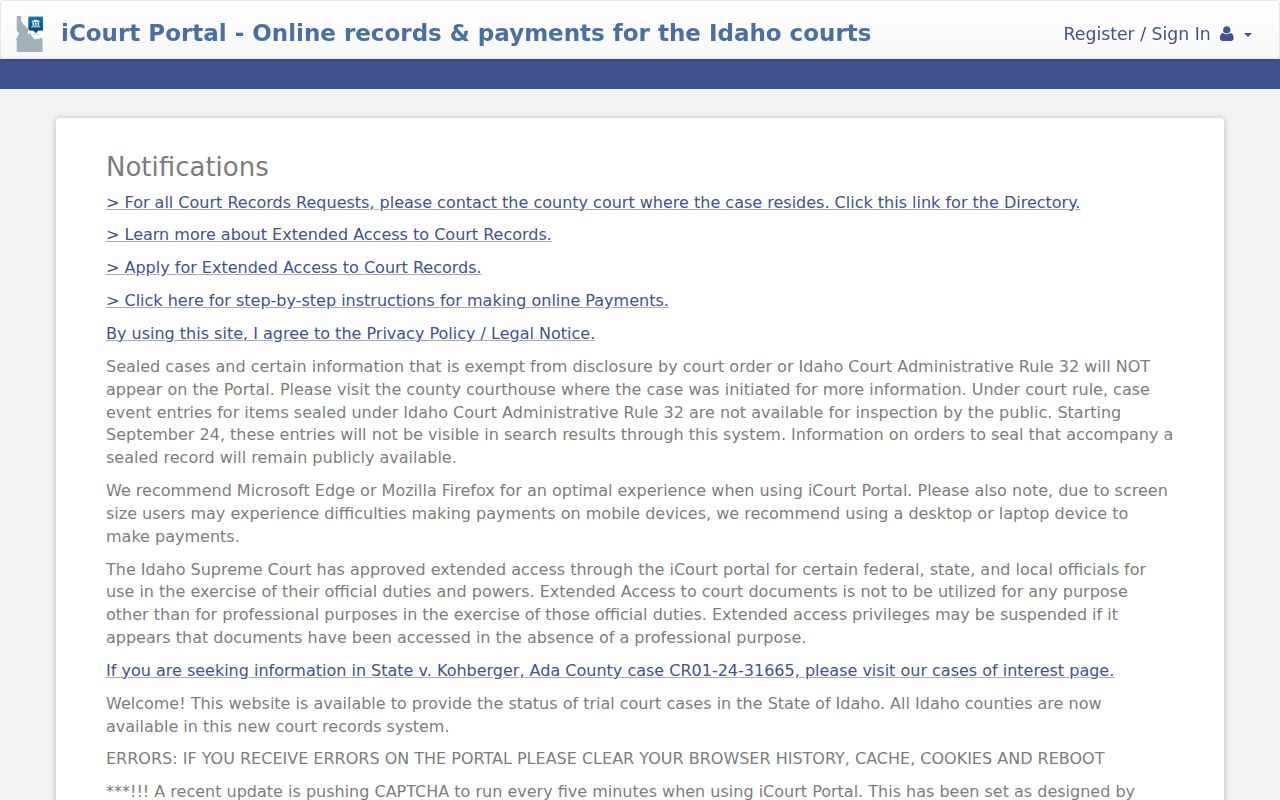
Use the result to capture the exact case number and filing court, then move to the clerk when the document itself is needed.
How to Search Case Records
A sound Valley County court search separates finding the docket from obtaining the official file. Online results can identify a case, while a courthouse kiosk or clerk request supplies authorized records that are not displayed on the web.
- Open Smart Search and choose the party-name or record-number route. Enter the most exact spelling or case number available.
- Use advanced filters when shown. Narrow the location to Valley County and apply criminal, status, or date filters that fit the event.
- Compare the case number, filing court, dates, party role, and charge details. Do not rely on the name alone.
- Review the docket events and each count's outcome. “Disposed” describes case status, not necessarily a conviction.
- Visit a courthouse kiosk or submit the clerk's judicial-record form for pleadings, orders, certified copies, or authorized hearing audio.
| Field or control | Type | Required | Use |
|---|---|---|---|
| Search Type / Smart Search | Tab or control | Yes | Select a party-name or record-number search. |
| Search Criteria | Text | Yes | Enter a party name or case or record number using displayed syntax. |
| Advanced Filtering Options | Expandable filters | No | May expose court, location, type, status, and date choices. |
| CAPTCHA verification | Challenge | Sometimes | Complete the human check if the portal requires it. |
| Search / Reset | Buttons | Search is required | Run or clear the query. |
Get Valley County Court Documents
The Valley County Court Clerk is the right custodian for pleadings, orders, register-of-actions material, certified dispositions, and court audio. Its direct judicial-record request form accepts documents, certified documents, regular audio, and FTR audio requests. Delivery choices are email, mail, or pickup, with postage flagged for mailed records. The form asks for case numbers or names and lets the requester identify criminal records and specific documents or hearing dates.
Valley County Court Clerk
219 N. Main Street
Cascade, ID 83611
208-382-7178
The clerk office image connects that counter to the Valley County criminal case file.
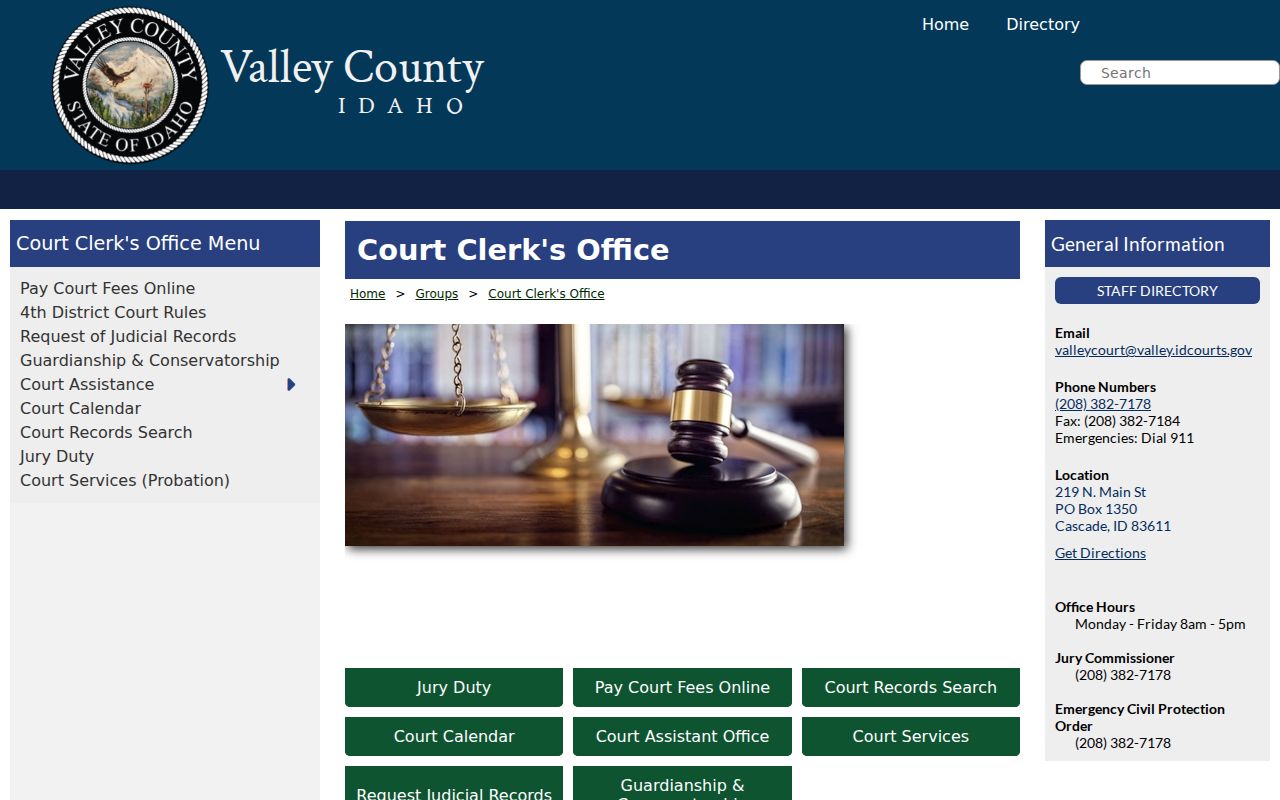
Older or non-digitized material also requires clerk help. Valley County does not post numeric copy, certification, audio, or postage fees, so ask for a cost before ordering.
What the Case File Shows
A case file records what prosecutors filed and what the court did. It should not be read as a booking sheet or officer narrative. Each count can follow a different path, so review the charge, amendments, disposition, and sentence at the count level.
| Case number and court | Identifies the proceeding, filing location, case type, and related court assignment. |
|---|---|
| Charging document | Shows the complaint, information, or indictment and the filed statutes or charge classes. |
| Docket entries | Lists filing and event dates, descriptions, motions, orders, and authorized linked documents. |
| Hearings | May show date, time, hearing type, location, and judicial officer. |
| Disposition and judgment | States the outcome for each count, such as dismissal, acquittal, guilty judgment, amendment, or withheld judgment. |
| Sentence and finance | Can identify an order, sentence, conditions, assessments, and an outstanding balance. |
Valley County Clerk Request Options
The Valley Judicial Records Request form is more detailed than the Sheriff's public-record form. It asks for contact and delivery details, case numbers or names, the record type, and the exact documents or hearing dates sought. Sealed-record or audio requests require a stated reason or relationship and photo identification. Uploading ID does not itself create a right of access; it gives the clerk facts needed to assess entitlement.
The official request form pictured here shows the route for Valley County judicial material.
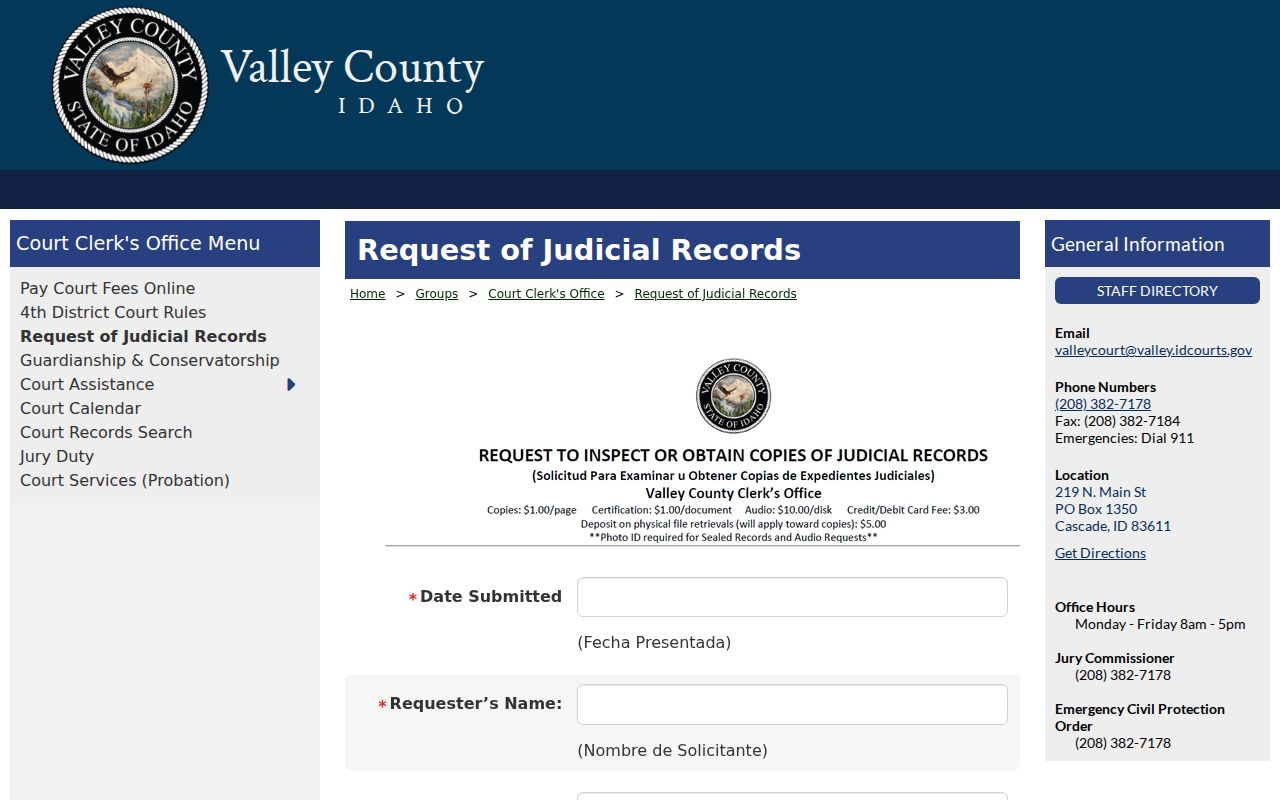
Use the Sheriff request only for police reports, photographs, or booking material. For compiled data spanning many cases, use the Idaho Judicial Branch compiled-data process rather than treating each line as a single clerk request.
Stages of a Criminal Case
A Valley County case can start with an arrest, citation, or summons. Prosecutor review then determines whether and how to file. Felonies may begin in the Magistrate Division for an initial appearance and preliminary proceedings before moving to District Court. Discovery, motions, and negotiations follow arraignment. A plea or trial produces a disposition, and the court then enters judgment and sentence where applicable. Appeals or post-conviction proceedings may create later entries.
Case flow: Charges Filed › Arraignment › Pretrial › Plea or Trial › Disposition › Sentencing
Case-number or location changes after bindover are a local search trap. Compare parties, charge facts, and dates before concluding that the later District Court entry is a new matter.
Not every path includes a jail booking. A citation or summons can lead straight to a court file, while a prosecutor may decline or alter an arrest charge before filing. The docket should therefore be read in date order. The first allegation supplies context, but the filed charging paper, later amendments, and count-specific disposition establish what the court actually considered. Probation, appeal, or post-conviction activity may add entries long after the first judgment.
Read Valley County Case Outcomes
Outcome terms carry more weight than the broad status label. A dismissal ends a charge without a conviction. An acquittal is a not-guilty verdict. A guilty judgment records conviction, while a withheld judgment reflects Idaho relief or sentencing treatment that must be read with the actual order. A plea may resolve fewer or amended counts than the first complaint listed.
- Arraignment
- The hearing where the charge and plea are addressed.
- Disposition
- The outcome of a case or individual charge.
- Information
- The prosecutor's formal charging document.
- Withheld judgment
- A judgment treatment whose effect depends on the Idaho order and later compliance.
- Sentence
- The consequence imposed by the court after a qualifying judgment.
A dismissed case can still appear in a court index or BCI record with that result noted. The final order is the best source for what the judge decided.
Concurrent and consecutive are also easy to misread. Concurrent sentences run together; consecutive sentences run one after another. Restitution is payment ordered for victim loss, while a financial balance in iCourt may include other court assessments. When the screen lacks enough context, request the sentence or judgment instead of inferring terms from a short docket label.
Access and Restrictions
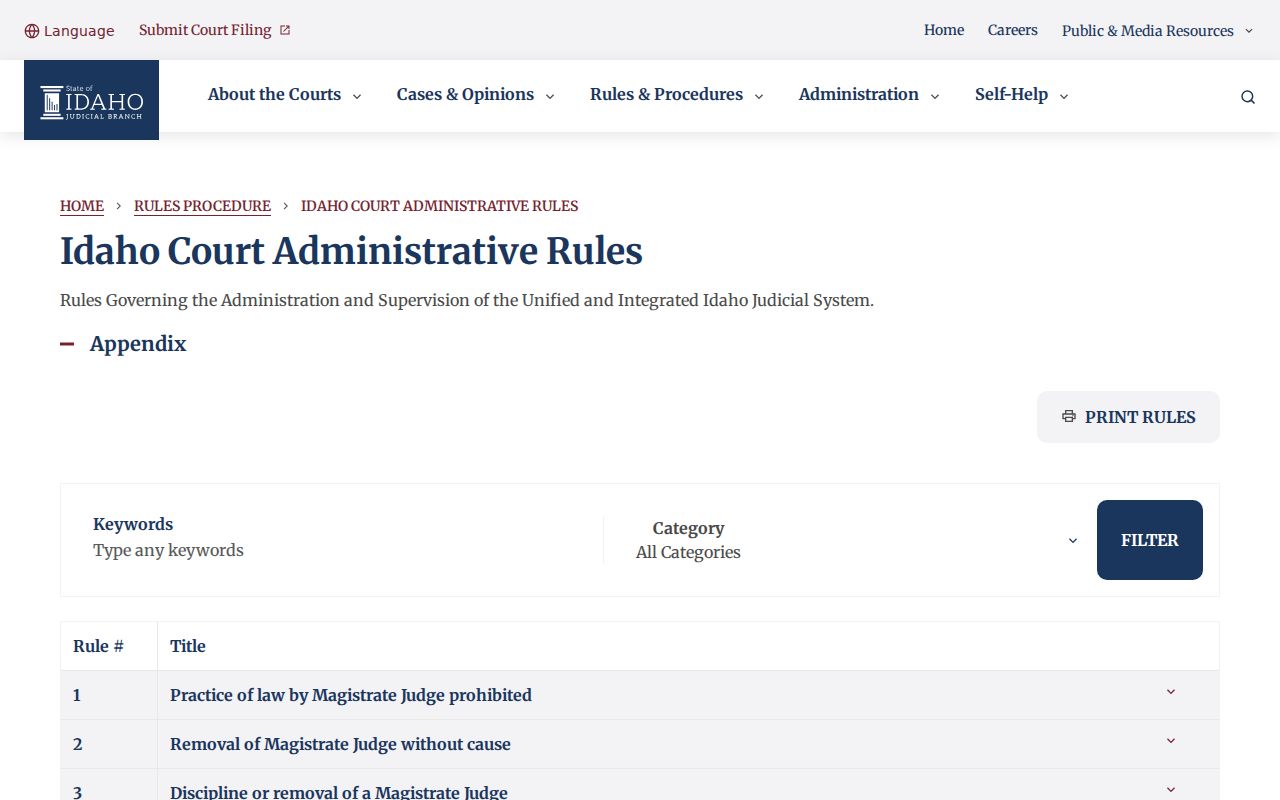
Valley County judicial records follow Idaho Court Administrative Rule 32, not the Sheriff's Idaho Public Records Act request process. Rule 32 governs access and protects confidential categories such as juvenile, sealed, and sensitive records. Full birth dates, Social Security numbers, victim or minor identifiers, and sealed documents are not public merely because a related docket entry exists.
The Rule 32 source shown here is the controlling access framework for Valley County criminal case records.
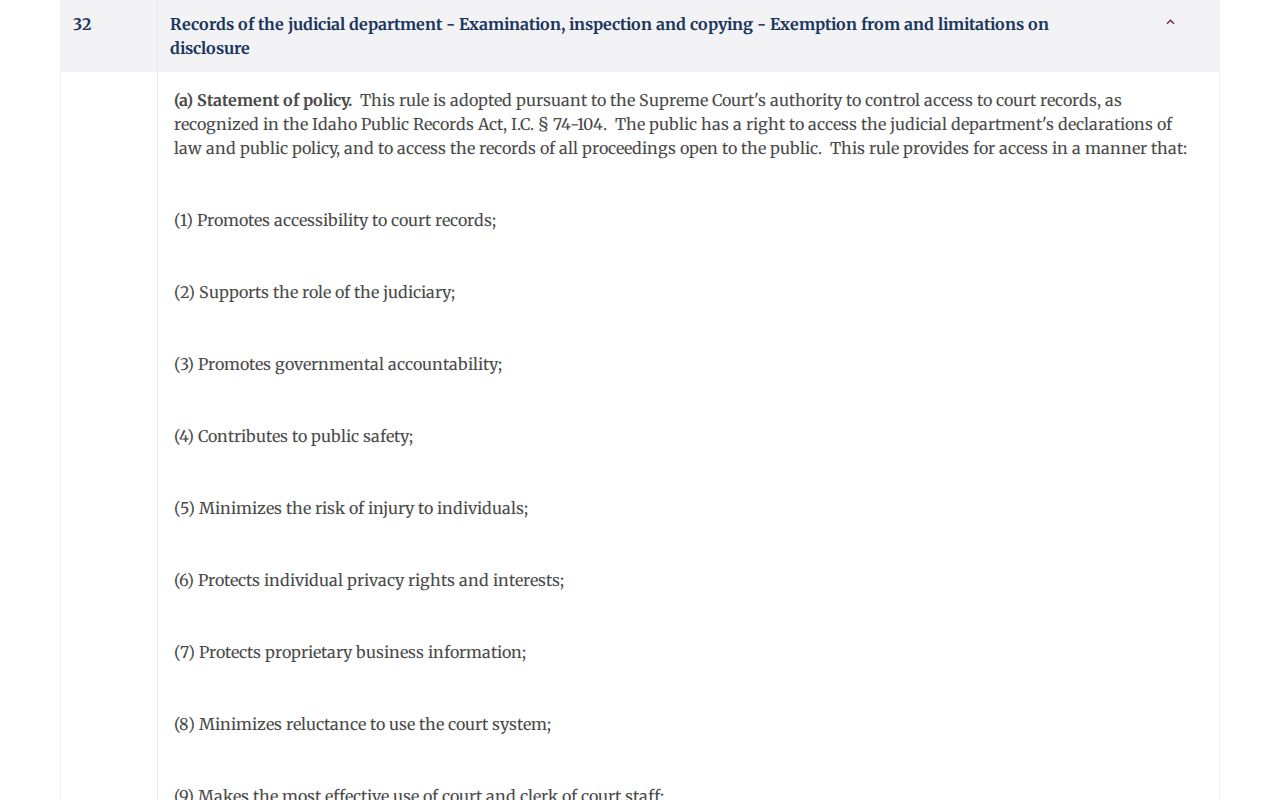
The broader Idaho Court Administrative Rules index places that rule within the judicial system.
When a case does not appear online, ask the clerk about older files, indexing limits, or lawful access instead of assuming that no Valley County proceeding exists.
Valley County Kiosk or Web
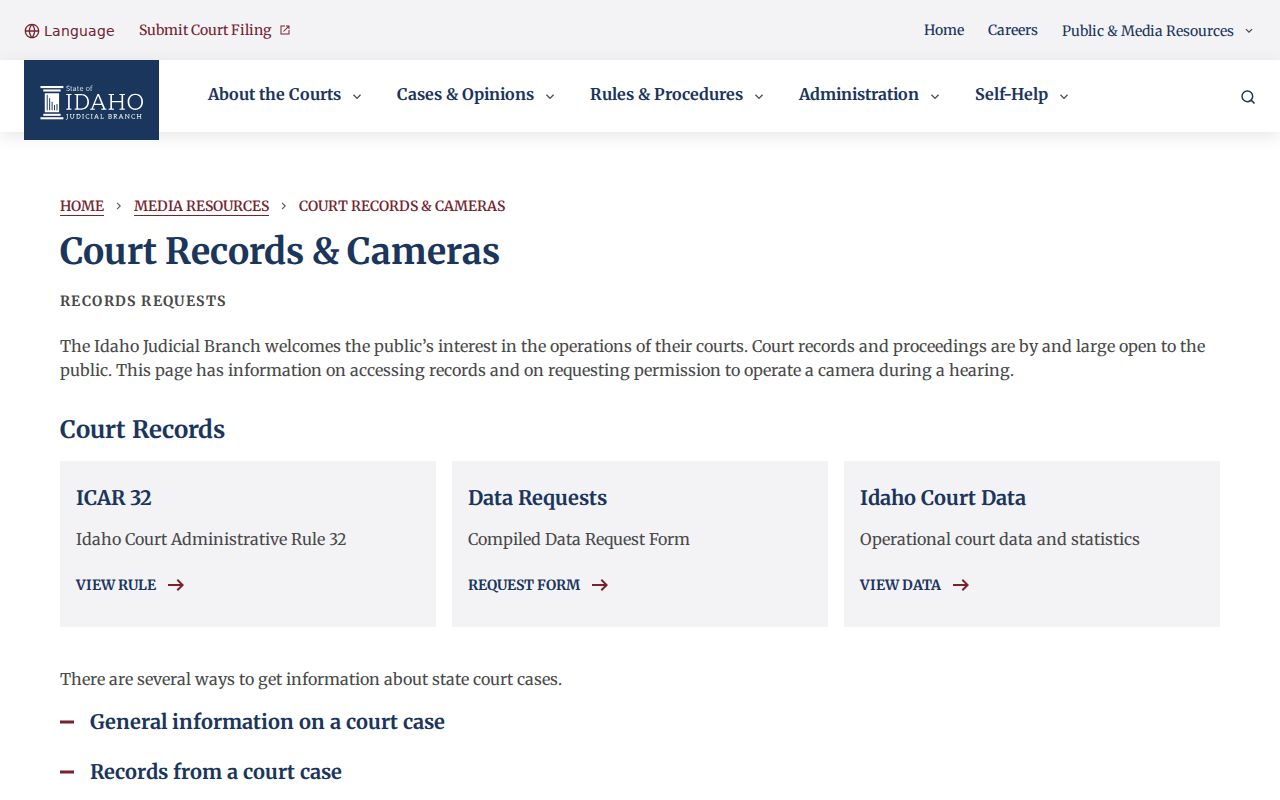
Idaho Courts states that case records may be available through courthouse computer kiosks or by request to the filing clerk. A kiosk can therefore be more useful than the web portal when the index confirms a Valley County case but does not expose the needed document. The clerk can also explain whether a copy, certification, audio format, identification step, or access restriction applies.
The Idaho court records access options pictured here reinforce the split between public viewing and a formal copy request.
For a case outcome that will be relied upon, request the certified disposition from Valley County rather than treating a screen result as the final record.